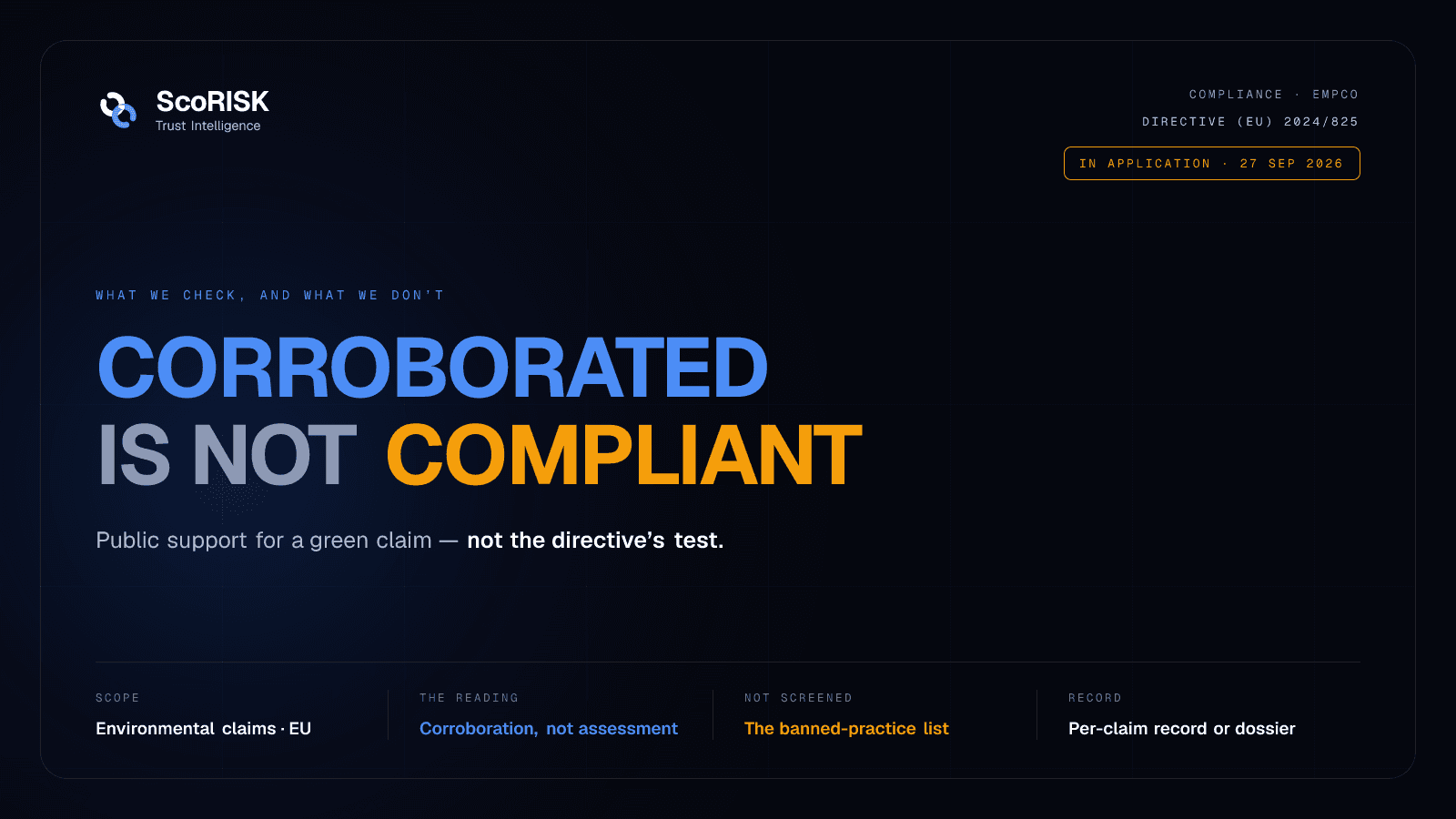
Since 27 September 2026, Directive (EU) 2024/825 — "Empowering Consumers for the Green Transition", or EmpCo — is in application: Member States must apply their transposing laws from that date. It changes the rules for environmental claims in advertising, on packaging, and in brand and product names.
Most summaries say it "requires green claims to be substantiated". That is about half of it. The other half is the one that catches people.
Three things the directive does
1. It bans some claims outright. These join the list of practices that are unfair in all circumstances:
- A generic environmental claim ("eco-friendly", "green", "climate friendly") where the company cannot demonstrate recognised excellent environmental performance relevant to the claim.
- A claim about a whole product, or a whole business, that is true of only one part of it.
- A claim that a product has a neutral, reduced or positive impact on greenhouse-gas emissions, based on offsetting.
- A legal requirement that applies to every product in the category, presented as a distinctive feature.
- A sustainability label that is not based on a certification scheme or set up by a public authority.
2. It tightens promises about the future. A claim such as "net zero by 2030" is misleading unless it rests on clear, public and verifiable commitments, set out in a detailed and realistic implementation plan with measurable, time-bound targets, and regularly verified by an independent expert whose findings are public.
3. The burden stays with the company. Under Article 12 of the Unfair Commercial Practices Directive, an authority can require a company to furnish evidence that a factual claim is accurate, and treat the claim as inaccurate if it does not. That evidence is usually the company's own: a life-cycle assessment, supplier declarations, certificates, test reports.
One clarification. The separate Green Claims Directive, which would set a detailed substantiation procedure, is still a proposal. It is not law.
Corroborated is not compliant
Take four claims:
- "Our packaging is eco-friendly."
- "Carbon neutral thanks to certified offsets."
- "Our bottle is made from recycled plastic" — when only the cap is.
- "CFC-free deodorant."
A search of the public web may find independent support for each of them. An offset registry confirms the second. The fourth is simply true.
None of that settles the question the directive asks. Offset-based neutrality is on the list whatever the registry says. "CFC-free" is a legal requirement for the whole category. "Eco-friendly" needs recognised excellent environmental performance, which no news article can supply. The bottle claim turns on what the claim actually covers.
A tool that searches the web and answers "supported" is answering a different question. That includes ours.
What ScoRISK does today
You paste a claim inventory — up to 50 claims, or a CSV. Name the brand, or your own website may count as independent. ScoRISK selects nothing: the list is yours. For each claim:
- ScoRISK searches public web sources.
- A language model judges whether that evidence verifies, disputes or contradicts the claim.
- ScoRISK then checks whether at least one cited source is published on a website not recognised, by its name, as belonging to the brand or to the subject named in the claim.
The reading combines the two. It is stored with the evidence, each source's authority tier and the model's stated relation to the claim, and it can be traced and re-exported as a per-claim record or a dossier.
That is a corroboration reading: do public sources other than your own say the same thing? As a first pass over an inventory it is useful. It points to claims where no source beyond sites recognised as your own was found.
Every compliance record and dossier also states what the reading is not:
- It is not an assessment under Directive (EU) 2024/825, under the Unfair Commercial Practices Directive, or under any national law transposing them.
- No practice on the banned list was screened.
- Future-performance claims were not checked for an implementation plan or for independent expert verification.
- ScoRISK did not see the evidence the company holds.
- "Independent" means "published on a website not recognised as the company's own". It does not mean independently verified. A site the company runs under another name, or a site republishing the company's own statement, may count.
- A favourable reading does not mean a claim is lawful. An unfavourable one does not mean it is unlawful.
What we are building next
Planned:
- A screen for the banned practices. A fixed, versioned set of rules reads each claim's wording for generic claims, offset-based neutrality, whole-product claims and legal requirements presented as distinctive. A flag is a prompt for review, not a finding: whether the practice is present still depends on facts that are not in the sentence.
- A flag for future claims. It marks a promise as needing a public plan and independent expert verification, which a web search cannot confirm.
- Search in the claim's language.
- Your own evidence. Upload certificates and life-cycle assessments, link them to claims, and the dossier shows them — because that is the evidence a regulator asks for.
- A dossier that names its framework and jurisdiction, and states which rules were applied and which were not.
Some things stay out of reach of a text check: a label printed on packaging, or a durability or repair claim that turns on facts about the product. The documents will say so rather than imply coverage.
ScoRISK supports your substantiation work. It does not make a claim compliant, and nothing here is legal advice.
A compliance tool that will not say what it did not check is asking you to trust it. We would rather you did not have to.